
What accuracy really means
What accuracy really means
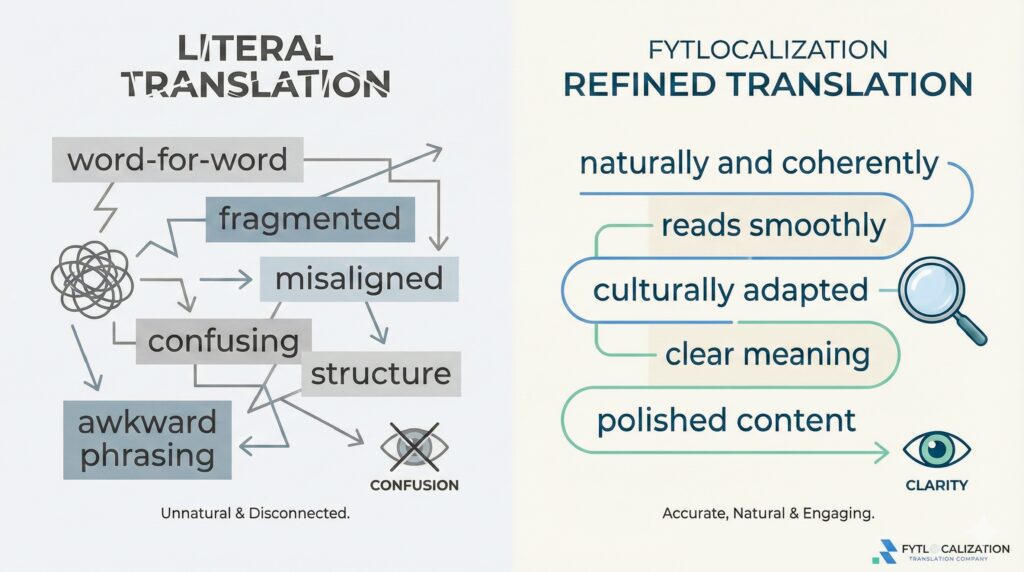
Most people assume translation is a mechanical swap: replace words in Language A with words in Language B. In reality, accuracy is the art of carrying meaning, purpose, and intent across languages without distortion.
A perfectly grammatical sentence can fail completely if it miscommunicates tone, mislabels technical terms, or ignores cultural context. For organizations building products, running campaigns, or operating across markets, those failures translate into confused customers, regulatory risk, and lost opportunities.
This guide explains what translation accuracy is in practice, why it matters across sectors, how to design production-ready workflows, and how to measure and protect quality.
What translation accuracy actually includes
Translation accuracy is multi-dimensional. A complete definition includes:
- Denotative accuracy (literal correctness): terms, figures, and facts are translated correctly.
- Pragmatic accuracy (intended effect): the message invokes the same action or feeling in the target audience.
- Terminological accuracy: technical terms, brand names, and legal phrases are consistent and correct.
- Cultural accuracy: metaphors, references, and idioms are adapted (or replaced) so the meaning remains intact.
- Register & tone: formal vs informal language, politeness, authority, or humor are preserved appropriately.
- Usability & format: the translated text fits UI constraints, verticals, SEO, or print layout as needed.
Accuracy is not one metric — it’s a set of guarantees that the target reader will understand and react the way the source intended.
Why translations go wrong
Understanding root causes helps fix them:
- Literal, word-for-word translation — loses idiomatic meaning.
- No glossary or terminology control — leads to inconsistent translations across pages/features.
- Lack of domain expertise — translators unfamiliar with the subject guess terms.
- Poor QA / rushed timelines — editors skip verification of critical passages.
- Bad hand-off or ambiguous source — poorly written source text creates ambiguity.
- Ignoring cultural variance — references or examples don’t make sense locally.
- Overreliance on raw MT (machine translation) without robust post-editing.
- No context for translators — they translate lines in a vacuum without UI/screenshots or intent notes.
The production-standard workflow for translation accuracy

A reliable pipeline reduces errors and speeds delivery:
Source preparation (write for translatability)
- Simplify sentences, avoid idioms when unnecessary.
- Provide context for each string: screenshots, UX flows, word limits.
- Create a domain glossary and style guide before translation begins.
Machine + human balance
- Use MT for high-volume drafts (if appropriate), but always follow with human post-editing.
- Choose MT engines tuned for your language pair or domain.
Qualified translators & transcreators
- Use linguists with domain experience (legal, fintech, health).
- For creative content, use transcreation specialists.
In-context review (LQA)
- Linguistic Quality Assurance (LQA) with checklists: correctness, fluency, terminology, cultural fit.
- UI/UX testing: see strings in the interface, not just in isolation.
Subject-matter adjudication (SME)
- For high-risk content, have an SME review and sign-off (legal, medical, financial).
Final QA & automation
- Use automated checks for number formats, links, tags, placeholders.
- Run a final linguistic pass for tone and register.
Post-launch monitoring & update
- Monitor customer feedback, support tickets, and analytics.
- Capture recurring localization issues and update the glossary and TM.
Tools, tech, and best practices
A modern stack and policies improve outcomes.
Tools
- CAT tools (SDL Trados, memoQ, Memsource, Lokalise) — maintain TM and glossaries.
- Terminology managers (TermBase, IATE-like) — enforce approved terms.
- LQA platforms — run linguistic QA at scale.
- QA automation — QA checkers for tags, placeholders, missing translations, and number formats.
- In-context editor — test translation in UI (e.g., Crowdin, Lokalise, Phrase).
- MT + PE workflows — integrate MT engines with human post-editing pipelines.
Best practices
- Lock down approved terminology for product / legal terms.
- Use short UI strings and provide context to avoid ambiguity.
- Maintain one authoritative source (source-of-truth) to prevent drift.
- Version-control translations like code.
- Localize early in the product lifecycle (not at product launch).
Quality metrics & KPIs for translation accuracy
Measure what matters, and you can improve it.
- Linguistic Quality Score (LQS) — subjective score from LQA reviewers.
- Term consistency rate — TM matches vs manual variants.
- Error categories — critical/major/minor counts per 10k words.
- Locale-specific support ticket rate — help requests linked to translated content.
- Time-to-fix — how quickly translation errors are corrected after detection.
- Conversion & engagement by locale — correlation between translation rollout and business metrics.
Set thresholds (e.g., ≤1 critical error per 10k words) and measure continuously.
Governance, security, and legal considerations
Translation accuracy isn’t only linguistic — it’s governance.
- Change control: require sign-off for meaningful translation changes.
- Retention & audit: store translated versions and change logs for compliance.
- Confidentiality: NDAs and access controls for translation vendors when handling sensitive text.
- Regulatory alignment: localized compliance language may require legal approval per jurisdiction.
Practical checklist for launching a translation project
- Source copy edited for clarity and translatability
- Glossary & style guide created and shared
- Selected MT engine and post-edit workflow (if used)
- Qualified translators assigned by domain
- LQA plan defined (criteria + reviewers)
- SME review defined for high-risk sections
- QA automation rules created (placeholders, tags, numbers)
- In-context checks in UI or document layout
- Monitoring plan for post-launch feedback and fixes
A short case vignette- how FYTLocalization solved a common problem
A fintech client had inconsistent terminology across onboarding flows in three African markets. Localized UI strings used different translations of the same financial term, causing customer confusion and increased support tickets.
Our solution:
- Built a compact glossary and integrated it into the client’s TM.
- Re-wrote UI microcopy with transcreation principles and shorter strings.
- Ran in-context QA with native testers on devices.
Result: Reduced locale-related support tickets by 27% in six weeks and improved onboarding completion rates.
Common pitfalls and how to avoid them
- Pitfall: Translating without context → Avoid by providing screenshots and intent notes.
- Pitfall: No terminology management → Avoid by building and enforcing glossaries.
- Pitfall: Relying on MT only → Avoid by human post-editing and LQA.
- Pitfall: Ignoring cultural resonance → Avoid by recruiting local reviewers and testers.
- Pitfall: Treating translation as an afterthought → Avoid by planning localization early.
Final thought
Translation accuracy is not an academic exercise. It impacts product adoption, legal safety, brand trust, and revenue. When organizations treat translation like interpretation — pairing technology with domain-savvy humans and robust QA — they get content that truly communicates.
If you’re preparing to scale into new markets or want to harden your translation process, Fytlocalization can help, we build glossaries, run LQA, operate transcreation workflows, and integrate translation memories into your CI/CD processes.
Ready to make your message travel without distortion?
Reach out to us Fytlocalization, and let’s design a translation standard tailored to your product and markets.