Africa is home to one of the richest language ecosystems on Earth, yet it is often discussed as a challenge rather than a strength. It will be interesting enough to unveil the wonders in African languages.
Across the continent, thousands of languages are spoken every day, carrying history, science, culture, and systems of social organization. These languages are not simply tools for communication; they are repositories of knowledge, shaped over centuries by the people who speak them.
To understand African languages is not just to study words, it is to understand how communities think, relate, trade, govern, and survive.
A Continent Built on Multilingualism
Africa is the most linguistically diverse continent in the world. it even becomes interesting knowing that these diversities bring about coexistence and connection rather than division
In many African societies, speaking multiple languages is not unusual, it is normal. A single individual may use one language at home, another in the marketplace, and yet another in education or formal settings.
This everyday multilingualism reflects deep social intelligence. It shows how African communities have long learned to navigate diversity, negotiate meaning, and live across cultural boundaries.
Living Languages, Not Relics of the Past

A common misconception is that African languages are fixed in the past. In reality, they are constantly evolving.
African languages adapt quickly to new ideas, technologies, and social changes. New words are created, meanings shift, and expressions evolve, just as they do in any living language.
From storytelling and music to radio, mobile phones, and digital platforms, African languages remain central to how people communicate, learn, and make sense of the world around them.
They are not disappearing. They are alive, flexible, and deeply expressive.
When Language Shapes Understanding
Language does more than transmit information, it shapes understanding.
When messages are delivered in familiar languages, they carry trust, clarity, and emotional meaning. When they are not, even well-intentioned ideas can feel distant or confusing.
Across everyday life in Africa, people rely on language not just to receive information, but to interpret it — to decide whether it is relevant, credible, or worth acting on.
This is why language sits at the center of how societies function.
From Sounds to Systems
Taken together, Africa’s languages form something far greater than a collection of dialects. They form systems — structured, connected, and historically grounded.
These systems did not emerge by accident. They grew through migration, trade, environment, belief, and shared human experience.
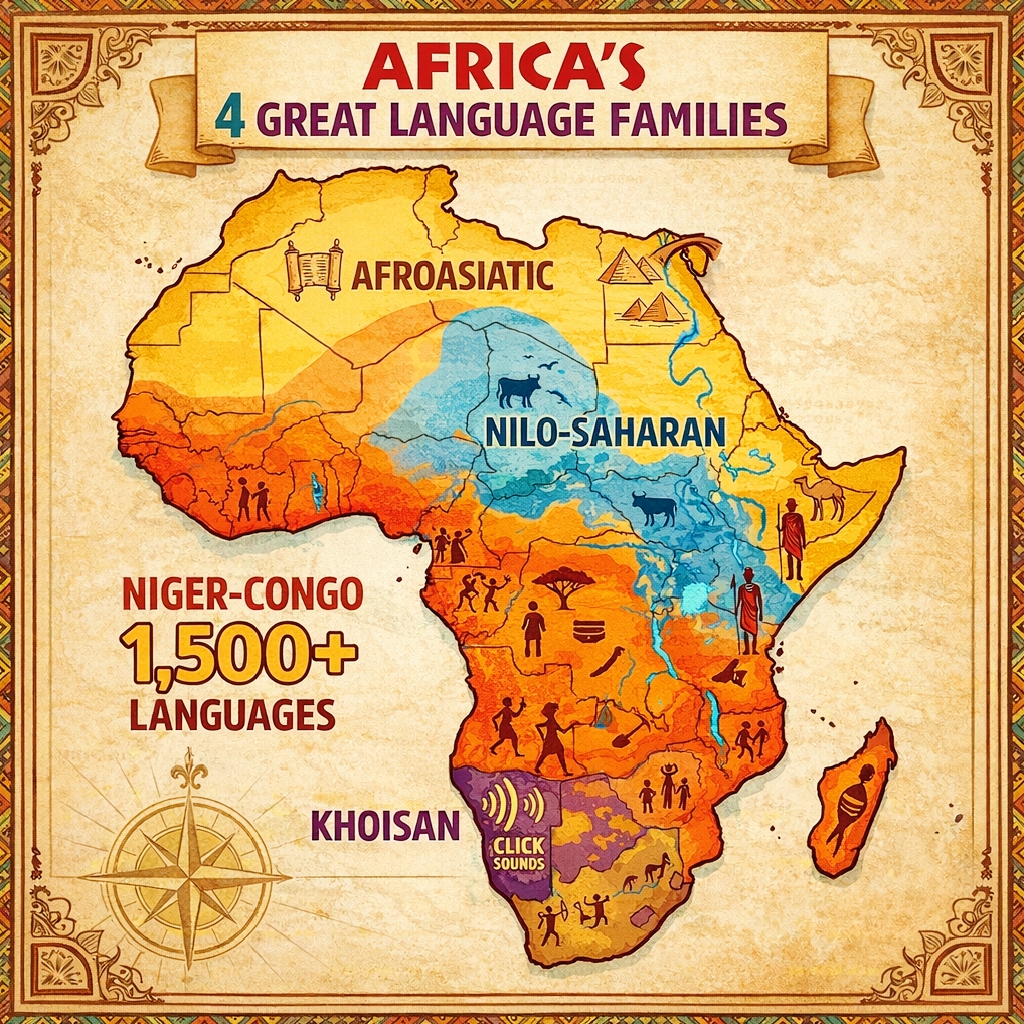
To see this more clearly, linguists often group African languages into four major families, each telling a different story about how people moved, lived, and communicated across the continent.
The Four Great Language Families of Africa 🌳
Africa is home to thousands of living languages, each carrying centuries of culture, knowledge, and human connection. Yet, despite this incredible diversity, African languages are often overlooked, treated as curiosities rather than powerful tools for understanding, connection, and innovation.
From the bustling markets of Lagos to the quiet villages of the Sahel, these languages are the pulse of daily life, shaping how people think, trade, educate, and govern.
Linguists often describe Africa as having four major language families, each with its own history, rhythm, and way of seeing the world. Understanding these families helps us see Africa not as fragmented, but as deeply connected.
1. Niger-Congo: The World’s Largest Language Family
The Niger-Congo family is the largest language family in the world by number of languages — and Africa is its heart.
It covers much of:
- West Africa
- Central Africa
- Southern Africa
Languages like Yoruba, Igbo, Zulu, Shona, Wolof, Akan, and hundreds more belong here.
A defining feature of Niger-Congo languages is how meaning is shaped through word structure and tone. Small changes in sound can signal respect, age, ownership, or emotion. Language here is not just about saying something, it’s about how (tune) you say it.
This family reflects Africa’s long history of migration, farming, trade, and social organization. It’s a linguistic map of how communities expanded, settled, and stayed connected over thousands of years.
2. Afroasiatic: Languages of Ancient Civilizations
The Afroasiatic family stretches across North Africa, the Horn of Africa, and parts of the Middle East.
It includes languages such as:
- Arabic
- Amharic
- Hausa
- Somali
Many Afroasiatic languages have deep written traditions, some going back thousands of years. They are closely tied to religion, governance, and scholarship, shaping how laws, trade routes, and belief systems spread across regions.
What’s fascinating here is how these languages balance oral strength with written history, adapting across deserts, coastlines, and empires, while remaining alive and evolving today.
3. Nilo-Saharan: Languages Along Rivers and Grasslands
The Nilo-Saharan family is less talked about, but no less important.
Spoken mainly across:
- Parts of East Africa
- The Nile basin
- Central Africa
Languages in this family are often linked to pastoral and river-based societies. They reflect environments shaped by movement, cattle herding, seasonal migration, and survival in open landscapes.
These languages carry precise ways of describing:
- Land
- Livestock
- Weather
- Community roles
They remind us that language grows directly from how people live.
4. Khoisan: The Sound of Humanity’s Earliest Speech
Perhaps the most famous, and most misunderstood, is the Khoisan family, found mainly in Southern Africa.
Khoisan languages are known for their click sounds, which are not decorative, but deeply meaningful. These sounds are among the oldest known human speech features, offering clues about early human communication.
Far from being “primitive,” these languages are highly complex, with sounds and meanings that require careful listening and cultural understanding.
They show us that Africa’s linguistic history doesn’t just explain Africa, it explains humanity.
A Living Map, Not a Museum Piece
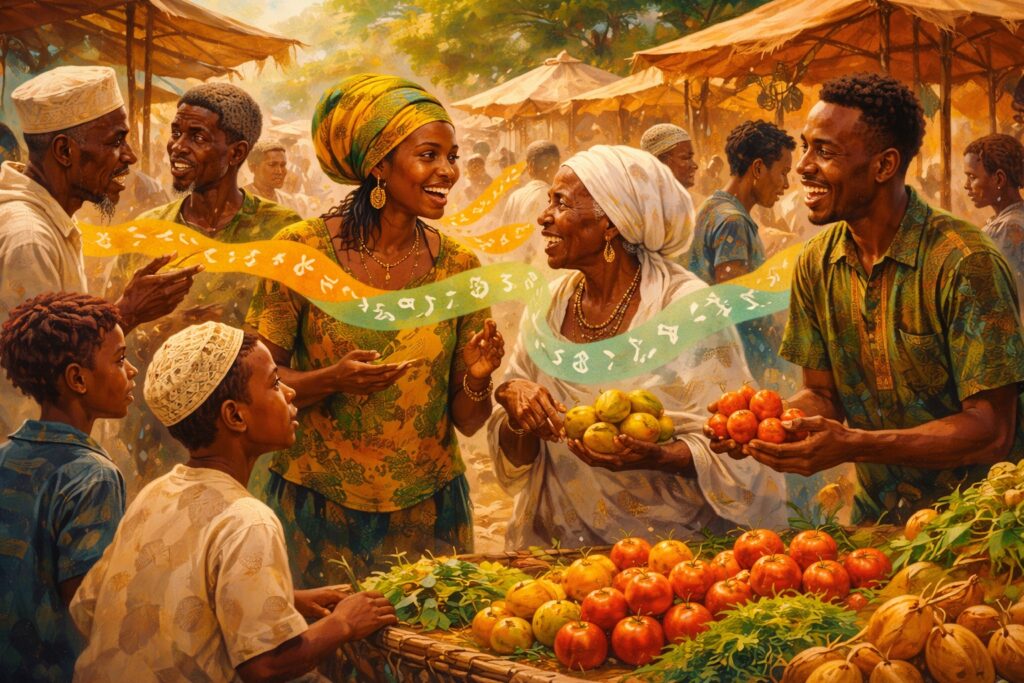
These four families are not frozen in time. They mix, adapt, borrow, and grow. Borders may divide countries, but languages often ignore those borders entirely.
Together, they form a living map of Africa’s:
- Movement
- Trade
- Belief systems
- Social bonds
Understanding them helps us see Africa as a continent of systems, not fragments.
Coming Next: When Languages Become Bridges 🤝
But diversity alone does not explain how millions of Africans communicate across ethnic and national lines every day.
How do traders, travelers, and communities speak to one another when their mother tongues differ?
How do some languages rise to become bridges across cultures and borders?
In the next post, we’ll explore Languages of Trade (Lingua Francas) — and how languages like Swahili and Hausa quietly power connection across Africa.
Because in Africa, language doesn’t just divide — it connects.