
Tax policy succeeds when people understand it. In Nigeria, making tax education available in local languages, via voice, SMS, radio, workshops, and localized digital journeys, is not just a communication extra. It’s a high impact compliance strategy.
Why language matters more than you think
Most tax reforms fail at the same point: not at policy design, but at public comprehension.
Policies are drafted in technical language and published in English. But many Nigerians, informal traders, market vendors, smallholder farmers, and even some urban micro-entrepreneurs, interact with public services through local languages, oral traditions, and community leaders. When people understand how a tax affects them practically (what to do, when, and how much it costs), they are far more likely to comply voluntarily.
The 2026 reforms are arguably the most pro-people in Nigeria’s history. For instance, individuals earning ₦800,000 or less are now fully exempt from Personal Income Tax. However, for a trader in Ariaria Market or a farmer in Kano, “exempted taxable income thresholds” sounds like a foreign language, even when spoken in English.
When complex laws are delivered solely in English, it creates a “Transparency Gap.” Taxpayers often view new laws with suspicion not because they are unwilling to pay, but because the technical jargon creates a barrier to trust.
How local-language education changes outcomes (evidence-based logic)
Local-language education changes the compliance equation by:
- Reducing friction: Simple, step-by-step instructions in a familiar language shorten the time it takes to register, file, or pay.
- Improving accuracy: Glossary-driven, localized wording reduces common mistakes (wrong tax codes, misplaced decimals, incorrect forms).
- Building trust: When message tone and messenger match community norms (trusted radio hosts, local leaders), resistance falls.
- Expanding reach: Voice and SMS reach low-literacy and low-connectivity audiences who often fall outside digital-first campaigns.
Even small improvements in voluntary compliance have outsized fiscal returns. For governments and payment platforms, the ROI is straightforward: higher collections + lower support costs.
Practical channels that work — and why
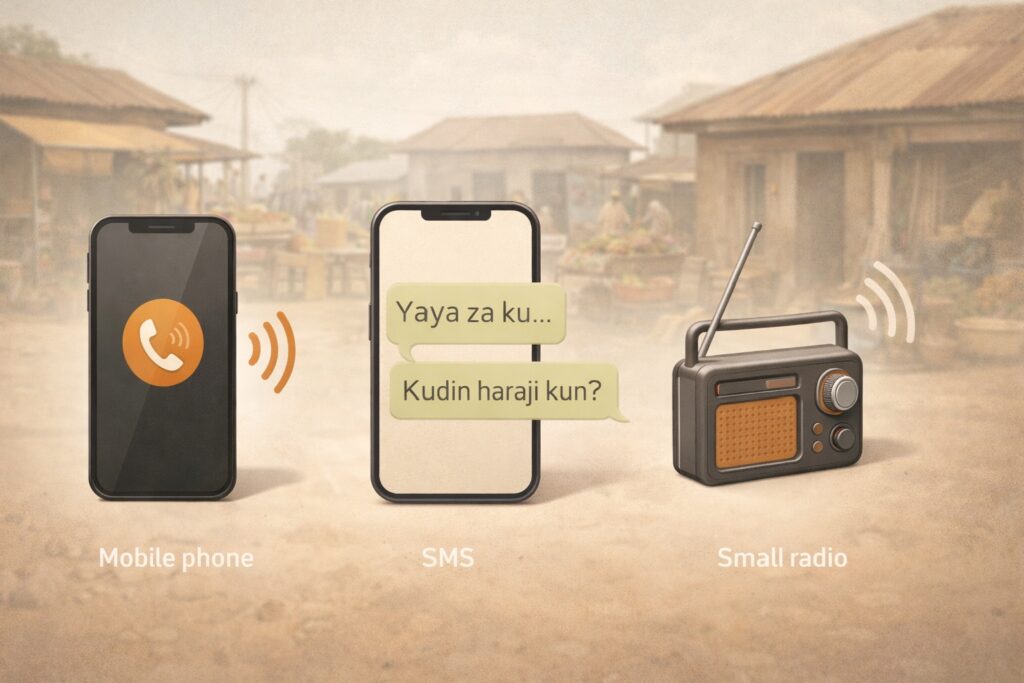
- Voice (IVR + recorded messages)
- Best for: low-literacy users, multilingual listeners, and complex step-by-step guidance.
- Why it works: People listen and act; IVR menus can guide users through registration flows in their language.
- SMS (in local languages / simplified English)
- Best for: short reminders, deadlines, confirmation codes.
- Why it works: SMS is low-cost, ubiquitous, and can be formatted as micro-lessons.
- Radio programs and spots
- Best for: mass awareness, myth-busting, and Q&A sessions.
- Why it works: Radio is trusted and has deep rural penetration across Nigeria.
- Community workshops & facilitator kits
- Best for: practical enrollment days, hands-on filing assistance.
- Why it works: Peer learning and demonstration increase confidence to act.
- Localized digital UI/UX
- Best for: fintech, e-filing portals, mobile money integration.
- Why it works: Clear microcopy, help texts, and error messages in local languages reduce abandonment and disputes.
What we actually deliver at FYTLocalization
We do more than translate. We design programs that convert policy into local action:
1. Rapid policy-to-language conversion
- Create plain-language summaries and glossaries in Hausa, Yoruba, Igbo, Pidgin, and other priority languages.
- Produce voice scripts, SMS sequences, and radio spot scripts that reflect local idioms and tone.
2. Channel-ready content production
- Record professional voiceovers and IVR flows in target accents.
- Produce short radio spots and radio series packages.
- Format SMS and USSD flows for low-bandwidth delivery.
3. In-context localization & testing
- Test messages with target audiences and iterate (community focus groups, A/B testing).
- Validate that terminology has the same legal meaning in each language with SMEs.
4. Field activation kits & training
- Deliver facilitator kits (slides, scripts, role-play prompts) for local agents and tax officers.
- Train community leaders and call-center agents to use localized scripts.
5. Measurement & continuous improvement
- Track KPIs (registration rate, error rate, filing timeliness, call-center volumes).
- Run feedback loops and update content based on analytics and community input.
Real-world example (illustrative vignette)
A state tax authority partnered with a localization team to roll out a simple SMS-driven VAT deadline reminder in Pidgin and Hausa plus a short IVR guide for traders. The result: a 22% drop in missed filings for small traders in the pilot markets and a 37% reduction in related support calls during the filing window. Anecdotally, traders reported feeling “less confused” and appreciated the clear steps sent in the language they used daily.
Why partners trust FYTLocalization
We combine language expertise, policy understanding, and delivery capabilities:
- Experienced linguists with sector knowledge (tax, fintech, policy)
- Fast content production (voice, SMS, radio) and rigorous legal validation
- Field-testing discipline and measurable KPIs
- Ethical data practices and consent-driven voice collection when needed
We don’t just translate words — we translate action.
Ready to pilot? Here’s the next step
If your organization is planning a policy rollout, payment update, or compliance campaign, we can design a localized education pilot in 6 weeks. We’ll provide a clear budget estimate, impact KPIs, and a deployment plan for your target states or markets.
Get in touch: Fytlocalization.com
Or email: admin@fytlocalization.com
Closing thought
Tax reform and financial inclusion are as much a communication challenge as they are a policy one. When governments, regulators, and platforms choose to meet citizens in the languages and channels they trust, policy moves from announcement to adoption.
Localization is the bridge. FYTLocalization builds it.