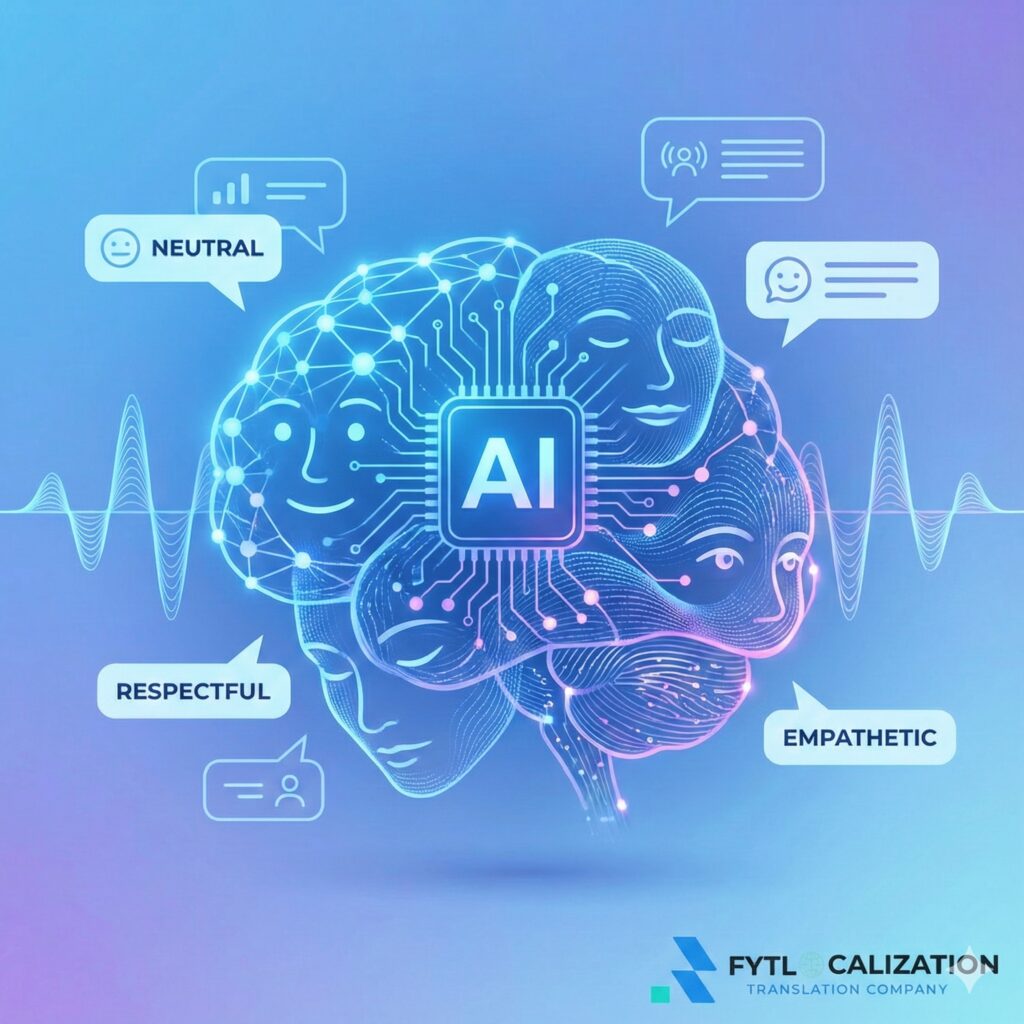
Artificial Intelligence has become remarkably good at processing language. It can translate text, summarize documents, generate responses, and even simulate conversation. Yet, despite these advances, one critical element of human communication is still frequently misunderstood by machines: tone.
Tone is not an optional layer of language. It conveys attitude, intent, respect, urgency, and emotion. Without it, words can easily lose their meaning, or worse, take on the wrong one. As AI systems increasingly mediate communication across cultures, industries, and languages, understanding tone is no longer a “nice to have.” It is essential.
This article explores why tone plays such a vital role in AI interpretation, where current systems fall short, and how a more human-centered, localized approach can bridge the gap.
Understanding Tone: More Than the Words Themselves
To understand why tone matters in AI interpretation, we must first acknowledge how humans communicate. When people speak or write, they rarely rely on words alone. Tone signals whether a message is polite or rude, formal or casual, serious or playful, urgent or relaxed.
For example, the sentence “That’s fine.” can mean acceptance, disappointment, or quiet frustration — depending entirely on tone and context. Humans intuitively recognize these differences. Machines, however, often do not.
This is where many AI language systems struggle. They are trained primarily on lexical patterns, the words themselves, without fully capturing the emotional and cultural signals that shape how those words are received. As a result, interpretation becomes technically correct but contextually wrong.
This limitation becomes even more pronounced when AI operates across different cultures and languages.
Where AI Interpretation Often Breaks Down
As AI systems expand into customer support, voice assistants, chatbots, and real-time translation, the consequences of tone misinterpretation become more visible.
A system might translate a message accurately but miss that it was meant to be reassuring. Another might respond in a tone that feels abrupt or dismissive to the user, even though the words themselves are neutral.
These breakdowns usually happen because:
- Training data lacks diverse tonal variations
- Cultural norms around politeness and respect are underrepresented
- Emotional cues are flattened during translation or interpretation
- Speech and text are treated as purely informational, not relational
At scale, these issues affect trust. Users may not consciously identify the problem as “tone,” but they feel that something is off. Over time, this erodes confidence in the product or service.
Understanding this challenge leads us to an important realization: tone is deeply tied to culture.
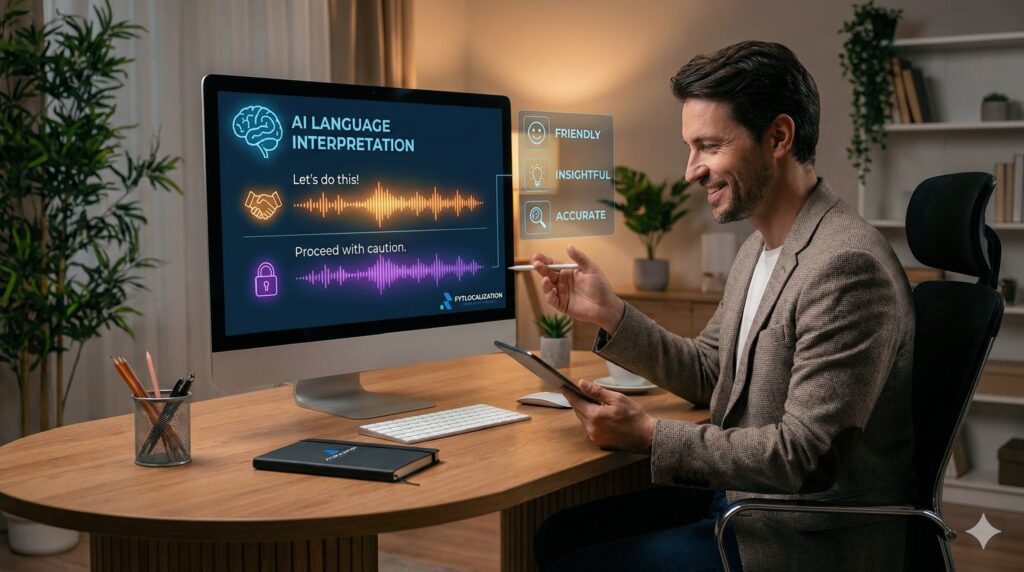
Tone Is Cultural — And Culture Is Context
Tone does not exist in isolation. What sounds polite in one culture may feel distant or cold in another. What sounds friendly in one language may feel overly familiar in a different context.
For instance, many African languages rely heavily on respect markers, indirect phrasing, and contextual cues. A direct translation that ignores these tonal norms can come across as disrespectful, even if the message itself is accurate.
This is why AI interpretation without localization is risky. Without cultural context, tone cannot be reliably understood or reproduced. The result is communication that is technically fluent but emotionally disconnected.
Recognizing this challenge shifts the conversation from “How accurate is the translation?” to a more important question: Does this interpretation feel right to the person receiving it?
The Role of Localization in Teaching AI Tone
This is where localization plays a transformative role. Localization goes beyond translating words; it adapts communication to fit cultural expectations, social norms, and emotional nuance.
When applied to AI interpretation, localization helps by:
- Introducing culturally appropriate tone variations into training data
- Ensuring speech and text models reflect real conversational patterns
- Preserving politeness, formality, and emotional intent across languages
- Aligning AI responses with how people actually speak and listen
At FYT Localization, we view tone as a core component of meaning — not an afterthought. By combining human linguistic expertise with AI workflows, we help systems interpret language the way people experience it, not just the way it appears on the surface.
This approach becomes especially critical in real-world applications.
Real-World Impact: Why Tone Matters in Practice
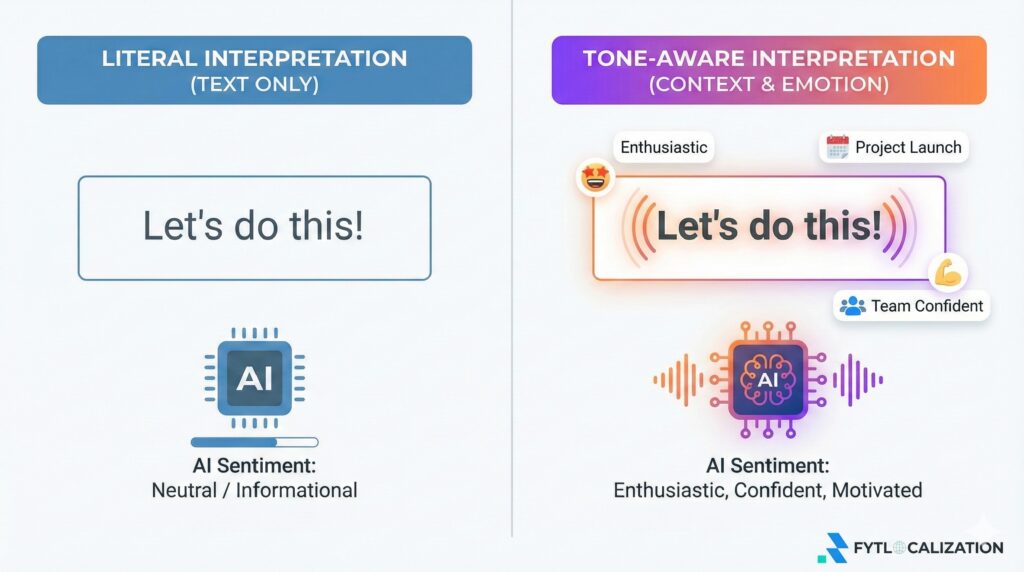
Consider a few common scenarios:
- Customer support: A technically correct response delivered in the wrong tone can escalate frustration instead of resolving it.
- Voice assistants: A flat or inappropriate tone reduces usability and user trust, especially in sensitive contexts.
- NGO and public service communication: Messages meant to reassure or guide communities can lose their effectiveness if tone is mishandled.
- Multilingual platforms: Users are more likely to engage when communication feels natural and culturally aligned.
In each case, tone directly influences how information is received — and whether it achieves its intended purpose.
Recognizing this reality forces organizations to rethink how they evaluate AI performance.
Rethinking “Accuracy” in AI Interpretation
Traditionally, AI language accuracy has been measured by correctness at the word or sentence level. But as AI becomes more embedded in human interaction, this definition is no longer sufficient.
True accuracy includes:
- Intent preservation
- Emotional alignment
- Cultural appropriateness
- Contextual awareness
Tone sits at the intersection of all these elements. An AI system that ignores tone may appear efficient but will ultimately fail to communicate effectively.
This understanding leads us toward a more human-centered future for AI language systems.
A Human-Centered Path Forward
The future of AI interpretation lies in collaboration — not replacement. Machines excel at scale and speed. Humans excel at nuance, emotion, and cultural understanding.
By integrating localized datasets, human review, and culturally informed design, AI systems can move closer to genuine understanding rather than surface-level processing.
At FYT Localization, we believe that when AI learns to respect tone, it learns to respect people. And when communication respects people, trust follows.
Final Thought
Language is not just about what is said, it is about how it is said and how it is felt. As AI continues to shape global communication, tone will remain one of the most important, and most human, elements to get right.
Organizations that recognize this today will build systems that communicate more clearly, connect more deeply, and serve people more responsibly tomorrow. Connect with us at Fytlocalization today to effectively implement your Ai project.