
How Speech Tech Is Redefining Access.
Africa is home to an astonishing linguistic diversity. A country like Nigeria alone has over 500 languages, and many tongues feature tonal variations and dialects. Until recently, most speech and translation technologies focused on high-resource languages – leaving African languages underserved. Now, as smartphones and connectivity spread even to rural areas, voice translation and speech recognition tools are emerging as powerful solutions. By converting spoken Swahili, Yoruba, Zulu or Hausa into English (and vice versa), these tools help communities access vital information without needing literacy. In short, voice tech is becoming the bridge across Africa’s language divide.
Real-World Applications.
Innovators and NGOs are already deploying voice and speech technologies in Africa with impressive results. For example, Digital Green’s Farmer.Chat is an AI assistant used in Kenya and Ethiopia to give smallholder farmers real-time advice in local languages. As Cassava Technologies and Rockefeller Foundation describe, Farmer.Chat “delivers trusted, localized guidance at nearly 100x lower cost than traditional extension,” and with on-continent compute, “we can unlock breakthroughs in speech-to-text, local language translation, [and] retrieval-augmented generation,” reaching millions of farmers with climate-smart advice. Similarly, Jacaranda Health in Kenya harnesses AI-powered voice tools to improve maternal care. With advanced local language models, Jacaranda has already started to “reach millions of women with critical health information in their native languages,” a capability that can empower informed healthcare decisions and prevent maternal deaths.
Voice tech is also enhancing business and service applications. Johannesburg startup GotBot provides chatbots on WhatsApp and Facebook that understand African languages; it automates banking, onboarding, and customer service in local contexts. Likewise, Botlhale AI develops voice-chatbots and voice biometrics tailored for African languages. – in effect eliminating language barriers in everyday transactions and support. These examples span agriculture, health, finance, and education, demonstrating that when people can speak instead of type, services reach wider audiences across Africa.
The Benefits of Voice Translation.
Voice translation brings major benefits for NGOs, governments and businesses seeking to serve diverse African populations:
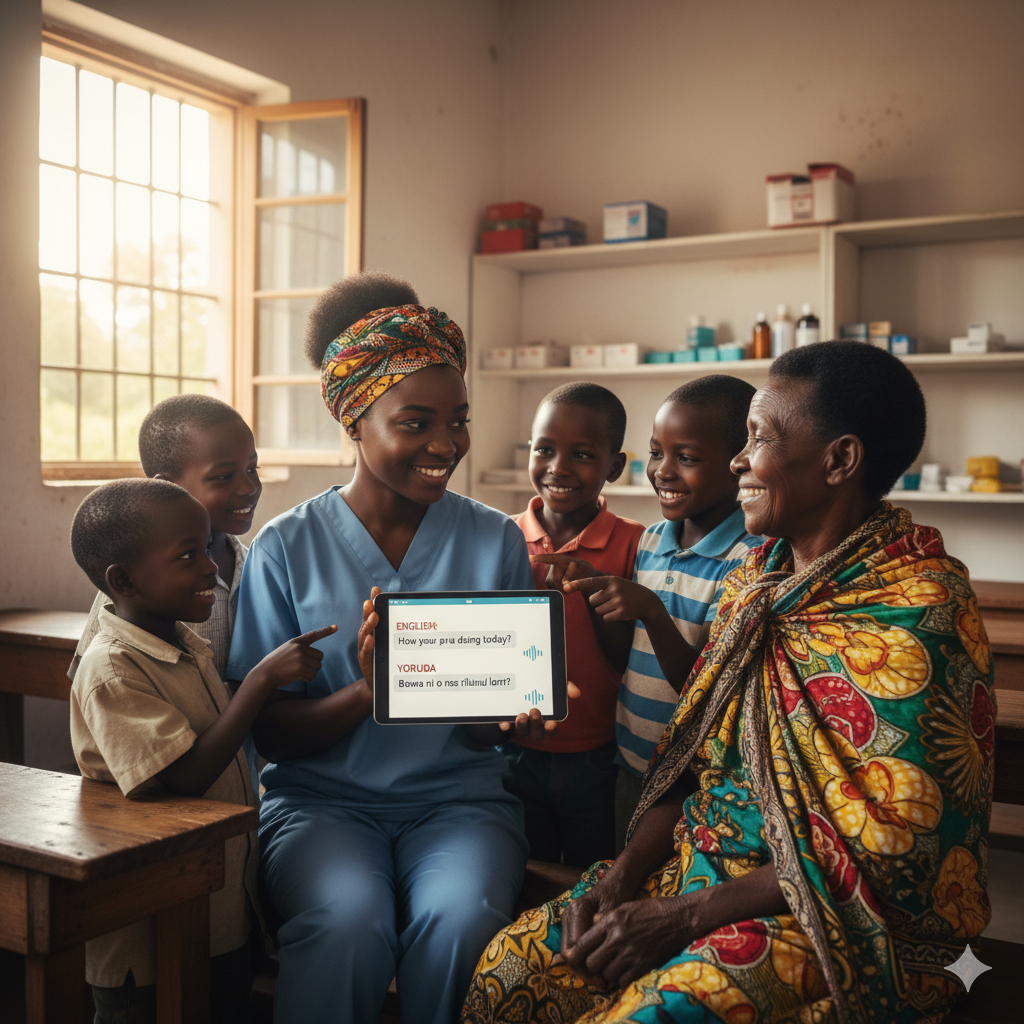
- Accessibility for non-literate users. Many regions have low literacy rates, especially among older adults or those in rural areas. Voice interfaces let people interact with apps and services by speaking, rather than reading or writing. As one study notes, “voice-based interfaces offer an accessible alternative to text-based communication” for illiterate users, opening use cases in farming advice, microfinance, healthcare support, and education. For example, a farmer can call an IVR hotline in Swahili and hear market prices or weather forecasts without needing to read.
- Breaking language barriers. By translating speech on-the-fly, voice tools allow speakers of African languages to tap into content and services that were previously blocked by language. Digital Green’s example shows how smallholder farmers get advice in their own language. Similarly, mothers receive maternal health tips in Swahili or Yoruba from Jacaranda’s AI, rather than struggling with English pamphlets. Startups like GotBot and Botlhale AI explicitly target indigenous tongues, so organizations can support customers or citizens in Zulu, Hausa, or Lingala for the first time.
- Expanded reach for services. Voice translation dramatically broadens the audience that can be served. An NGO with voice-capable apps can include rural villagers and nomadic communities who lack formal education. Researchers note that improving speech-to-text in African languages “could drastically improve user engagement with technology” and include those who only speak local languages. In practice, this means radio campaigns or audio hotlines can be integrated with AI translation so that a single program reaches people across Kenya’s and Tanzania’s language zones. As one innovation lead put it, effective voice AI can put information “in the hands of every farmer, helping them grow more resilient and prosperous”
Challenges in Voice Translation.
Despite the promise, voice translation in Africa faces significant hurdles. Key challenges include:
- Linguistic diversity and dialects. As noted, one language can have dozens of local dialects. Tonal languages (where pitch changes meaning) require careful handling. NLP experts warn that dialectal variation “may differ dramatically even within a 50-kilometer radius,” making it hard to build one-size-fits-all models. Bridging these requires collecting speech from many regions and training models on tonal nuances, which is resource-intensive.
- Data scarcity. Most African languages lack large annotated speech corpora. Without big datasets, ASR and translation models struggle to reach accuracy. Researchers highlight underrepresented data as a core gap: “Many African languages lack large datasets for training AI models,” and building them from scratch is challenging. Initiatives like Mozilla Common Voice and collaborations like NLP Ghana’s Khaya AI are helping (Khaya now supports Twi, Yoruba, and plans more), but much work remains.
- Cultural and contextual accuracy. Translation isn’t just literal; it must respect cultural nuance. AI experts note that models must be trained responsibly “to respect cultural nuances”. A medical tip voiced word-for-word from English may confuse local contexts. Building culturally aware voice systems often requires local stakeholder input, which can slow development.
- Infrastructure limitations. Reliable power, internet and mobile coverage are still spotty in many rural areas. Collecting or streaming high-quality audio demands stable networks. In practice, projects may resort to low-data apps or offline mode. For example, in speech data collection one must “optimize for low-resource environments” with lightweight recording and offline functionality.
Each of these challenges slows adoption. NGOs must balance enthusiasm for “voice is the new blood” of tech with realities on the ground. However, where success has occurred, it’s because solutions were tailored locally – and partnerships bridged the gaps.
Collaboration and the Path Forward.
The future of voice translation in Africa hinges on collaboration between technologists, NGOs, governments, and communities. Global tech firms (Google, Microsoft, Meta) have begun adding African languages into their translation and voice APIs, often working with local researchers. Foundations and funders, like Cassava Technologies and the Rockefeller Foundation, are investing in local AI infrastructure so African innovators can scale solutions for agriculture, health and education. For NGOs, teaming up with startups accelerates impact – for example, an aid agency might adapt a voice chatbot from an African startup rather than building one from scratch.
Capacity-building is also key. Training more data-collection teams and crowdsourcing recordings (with ethical consent) can grow voice corpora. The continent’s own researchers stress open-source networks like Masakhane to share translation models. Importantly, NGOs bring trust and community access; partnering with them ensures voice tools are deployed where they’re needed most. As one tech CEO noted, adding African compute on the ground means AI can be “in the hands of every farmer” or mother, not just urban centers.
In the coming years, we expect voice translation to become a standard tool in Africa’s service toolkit. For NGOs and businesses, embracing speech technology for African language access means a quantum leap in inclusion. By working together – combining African language expertise with modern AI – stakeholders can scale voice-driven solutions. This collaboration will help overcome the remaining obstacles, ensuring that voice translation in Africa truly redefines access.
Ready to make your services more inclusive? Discover how FYTLOCALIZATION can help you connect with African audiences through voice-powered translation. Visit our website to get started or reach out for a personalized consultation.