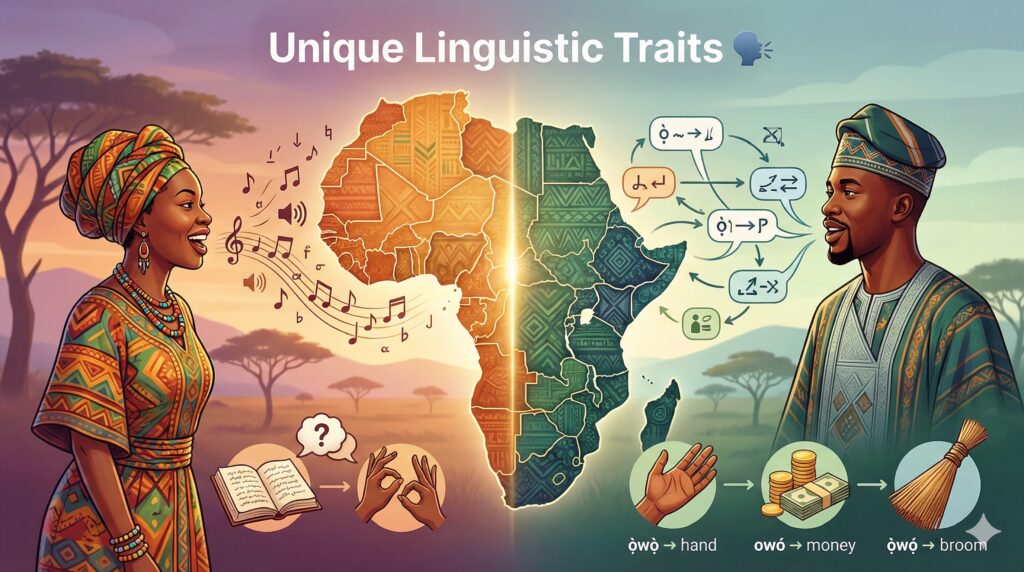
The Unique Linguistic Traits That Make African Languages Extraordinary
Language is not just something we use in Africa.
It’s something we perform.
Across the continent, meaning doesn’t live only in words. It lives in sound, pitch, rhythm, pause, and context. A slight change in tone can flip meaning entirely. A click of the tongue can replace a consonant. A sentence can carry emotion, intention, and history all at once.
To outsiders, this richness can feel surprising.
To Africans, it’s simply how communication works.
In this chapter of our African Languages series, we explore the unique linguistic traits that make African languages some of the most expressive, and most misunderstood, languages in the world.
When a Sound Is a Letter: The Famous Clicks of Southern Africa 👅
Some of the most distinctive sounds in human language come from Southern Africa, where clicks are not effects or gestures—but actual letters.
Languages such as Xitsonga, isiXhosa, isiZulu, and Khoisan languages use clicks as part of their normal sound system. These clicks are made by drawing air inward rather than pushing it out, creating sharp, rhythmic sounds.
In parts of Southern Africa, some languages use clicks as full consonants, not accents. In isiXhosa, for instance, the click written as “c” is a real sound that changes meaning. The word “cela” means to ask, while “cima” means to switch off. These clicks are not added for flair, they are foundational. Without them, words lose their identity.
What’s remarkable is not just that clicks exist, but how naturally they function:
- They form words
- They change meaning
- They are learned from childhood like any other sound
For native speakers, clicks are effortless.
For learners and machines, they are famously difficult.
Clicks remind us of something important: human language evolved in many directions, and African languages preserve some of its most ancient and creative paths.
When Pitch Changes Everything: The Power of Tone
In many African languages, how you say a word matters just as much as what you say.
Languages like Yorùbá, Igbo, Akan, Ewe, Shona, Zulu, and many others are tonal. This means the pitch of a syllable—high, mid, or low—can completely change meaning.
The same word, spoken with a different tone, may mean:
- a person
- an object
- an action
- or something abstract
Take Yorùbá, for example. The word “owo” can mean entirely different things depending on tone. Said one way, it means hand. With a different pitch, it becomes money. Change the tone again, and it can mean broom. The spelling stays the same, but the meaning shifts completely. In tonal languages, tone is not decoration, it is the message.
To non-tonal language speakers, this can feel unfamiliar. But for tonal language speakers, tone is as natural as breathing.
Tone allows African languages to:
- Carry more meaning with fewer words
- Convey emotion subtly
- Maintain musicality in everyday speech
This is why African languages often feel alive, expressive, and deeply human.
When Rhythm and Context Speak Louder Than Words
African languages are rarely rigid or mechanical. Many rely heavily on:
- Context
- Shared understanding
- Cultural rhythm
A sentence may be short, but its meaning expands through:
- who is speaking
- where it is spoken
- how it is delivered
In many communities, pauses, repetitions, proverbs, and indirect phrasing are not weaknesses, they are features. They allow speakers to be respectful, persuasive, humorous, or cautious without saying everything directly.
In Swahili for example, meaning can shift depending on how words flow together. A phrase spoken smoothly may express affection, while the same words delivered with pauses can signal choice or intention. Communication here is not only about vocabulary — it’s about how language moves.
This is why literal translation often fails.
And why understanding African languages requires listening beyond the words.
Why These Traits Matter More Than Ever 🌍
These linguistic features are not curiosities.
They are systems of intelligence built over centuries.
They shape how people:
- Think
- Learn
- Trust information
- Share knowledge
Any effort to communicate, educate, govern, or build technology across Africa must reckon with this richness. Ignoring it doesn’t simplify communication — it breaks it.
African languages are not “complex” for the sake of it.
They are complex because human life is complex.
A Gentle Pause Before the Next Chapter
So far in this series, we’ve explored:
- Africa’s great language families
- The bridge languages that connect millions
- And now, the unique traits that give African languages their power
Next, we’ll move forward—to explore how these very traits are shaping modern communication, technology, and AI.
Because the future of global communication will not be built on fewer languages.
It will be built on understanding them better.