Transcription is often treated as a simple “word-for-word” task: convert speech into text and move on. In practice, transcription is an interpretive act. The way something is said — the pauses, the emphasis, the sighs and laughs — frequently changes the meaning. For teams building products, auditing conversations, or training speech models, losing those signals is not just inconvenient: it’s costly.
Below is a practical, structured guide to why transcription must preserve meaning, how to do it well, and what a production-ready workflow looks like — with examples you can use immediately.
What Audio Transcription Accuracy Really Means
Accurate transcription does three things simultaneously:
- Converts audio to text with minimal lexical errors.
- Preserves paralinguistic features (tone, pauses, non-verbal sounds).
- Makes the transcript actionable for downstream users (researchers, developers, compliance officers).
A transcript that meets only the first goal is merely a transcript. One that meets all three is a reliable record and a decision-making tool.
Quick illustration: the phrase “I’ll do it next week” can be an enthusiastic commitment, a reluctant promise, or sarcastic dismissal — depending on tone and pause. Noting those cues changes how stakeholders act.
Meaning lives in the margins: tone, pauses, and non-verbal cues
Audio contains several layers beyond words:
- Prosody (intonation, pitch, stress) — tells us emphasis and emotion.
- Pauses and pacing — indicate hesitation, processing, or dramatic effect.
- Non-verbal cues — laughter, sighs, throat clearing, background noise.
- Speaker dynamics — interruptions, overlaps, speaker distance from mic.
A transcript that ignores these will read like a flat script, not a human interaction. For example:
Audio: (two people on a call)
A: “We’ll launch next week.”
B: (chuckles) “If everything goes perfectly.”
Verbation-only transcript:
A: We’ll launch next week.
B: If everything goes perfectly.
Meaning-preserving transcript:
A: We’ll launch next week.
B: (chuckles) “If everything goes perfectly.” (implying doubt)
The second version preserves B’s skepticism — a detail that matters for product planning, sentiment analysis, or legal records.
Why Tone, Emphasis, and Context Are Often Lost in Transcription
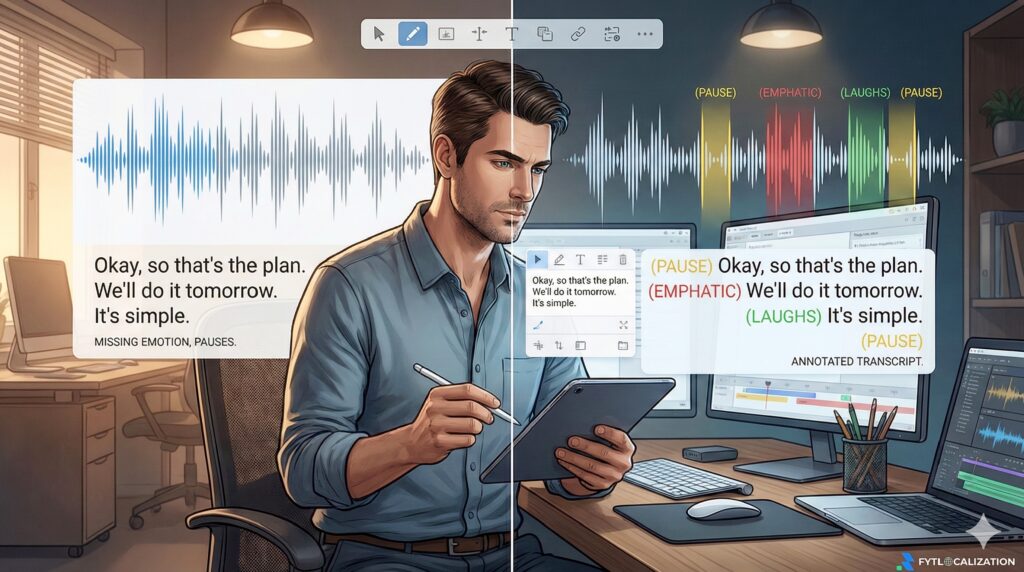
Automatic speech recognition (ASR) has advanced rapidly, but most ASR outputs are plain text with no prosody markers. Even human transcribers can miss subtle cues if they’re rushed, unfamiliar with local speech patterns, or lack a clear annotation standard.
Common causes of meaning loss:
- Over-reliance on verbatim word capture without annotating tone.
- Untrained transcribers who don’t know when a laugh or a pause is meaningful.
- Lack of domain glossaries (so names and jargon are guessed).
- No diarization — making it hard to follow speaker dynamics.
When teams ignore these, decisions built on transcripts (product roadmaps, legal claims, sentiment analysis, model training) suffer.
Real-World Risks of Inaccurate Audio Transcriptions
Below are practical situations where meaning matters — and what can go wrong when it’s missing.
Customer support and compliance
A customer consent call missing a hesitation marker or an unclear “I don’t know” can lead to regulatory headaches. Annotating uncertainty and pauses helps legal and QA teams verify true consent.
Market research and interviews
Researchers rely on nonverbal cues to detect discomfort or irony. A transcript that strips laughter and sighs will mislead analysis and skew findings.
Media and content creation
For podcasts and videos, time-stamped markers for laughs, applause, or music make editorial work efficient and improve accessibility.
AI training datasets
Models trained on transcripts without prosodic labels perform worse in sentiment and intent detection. Annotated datasets yield more robust downstream models.
How Human-Aware Transcription Improves Understanding
Human-aware transcription blends technology with skilled annotation to preserve meaning. Key elements are:
- Diarization: Clear speaker labels and turn boundaries.
- Non-verbal tags: Standardized markers like (laughs), (sighs), (long pause — 2s).
- Prosodic notes: Only where they change interpretation: [emphatic], [sarcastic], [quiet].
- Timecodes: Timestamps to quickly reference audio.
- Confidence flags: Mark unclear segments as [inaudible] or [unclear] so teams can review originals.
These annotations translate speech into a richer, more usable record.
Audio Transcription in Multilingual and African Contexts

Local speech patterns, code-switching, and dialectal features make accurate transcription especially challenging — and especially valuable — in African contexts. A dataset collected for South African English or Nigerian Pidgin, for example, requires annotators who recognize local intonation, common lexical blends, and cultural markers.
A recent short audio collection project we ran reinforced this: transcribers familiar with regional speech produced higher-quality annotations and flagged meaningful non-verbal cues that standard ASR missed. That local knowledge turned raw audio into trustworthy data.
Where Accurate Transcription Matters Most Today
Make transcription standards non-negotiable for:
- Regulated communication (healthcare, legal, finance)
- Customer support insights and churn prevention
- Market and user research (qualitative richness)
- Speech-AI training and evaluation
- Content production and accessibility
When stakes are high, transcripts must be documents of meaning, not just words.
Our Approach to High-Accuracy Audio Transcription at Fytlocalization
At Fytlocalization we combine scalable ASR with expert human post-editing and a strict annotation standard. Our typical pipeline includes:
- Pre-flight glossary creation — domain terms, names, acronyms.
- ASR pass — fast base transcript.
- Human post-editing — correct lexical errors and apply meaning tags.
- Quality review — second-pass QA with spot checks and IAA measurement.
- SME adjudication — for legal/medical or high-risk content.
- Structured export — timestamps, speaker IDs, non-verbal markers, confidence flags.
This hybrid model balances speed and fidelity — essential when you need scale without sacrificing interpretation.
Quick Checklist: Practical Standards to Adopt Now
- Create a one-page transcription standard (tags, timecode interval, diarization rules).
- Build and share a glossary before starting transcription.
- Use ASR + human post-editing for accuracy and meaning.
- Annotate non-verbal cues and prosodic signals that affect meaning.
- Run dual-review for high-stakes transcripts.
- Log recurring errors and update guidelines regularly.
Closing thought and call to action
Words on a page are useful only when they carry the same meaning as the original voice. Treat transcription as both interpretation and documentation. When done right, transcripts become strategic assets — supporting legal clarity, better research, safer products, and stronger AI.
If you’d like, Fytlocalization can help you design a transcription standard, pilot a meaning-focused dataset, or post-edit and QA your transcripts for production. Let’s ensure your audio says what you think it says — everywhere it matters.