
Intro — A new era of meaning
Africa is speaking louder than ever — and technology is finally learning to listen. With thousands of languages and rich cultural nuance, the continent presents both a huge challenge and an unprecedented opportunity for communication. The future of translation in Africa won’t be AI or humans — it will be AI with humans: fast, scalable, and deeply local. For brands and organizations that want to connect across Africa, mastering that blend is now a business imperative.

To understand why this hybrid approach matters, let’s first look at the forces reshaping communication across African markets.
Why translation matters now more than ever
Africa is home to over 2,000 languages and hundreds of ethnic groups — each with its own rhythm, meaning, and worldview. Nigeria alone has more than 200 ethnic groups, yet only a few languages like Yoruba, Hausa, and Igbo dominate mainstream communication.
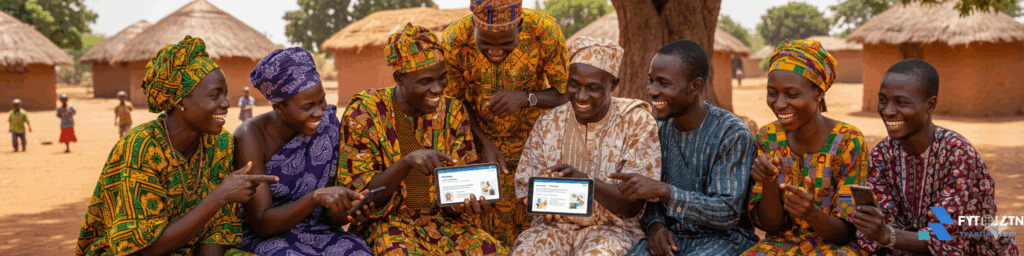
When businesses — local or international — tailor their products and content to smaller communities in their own dialects, they build instant trust. Imagine a healthcare app giving voice instructions in Tiv or Kanuri, or an agricultural platform sending weather alerts in Fulfulde — such efforts do more than translate words; they communicate care.
For example, in Kenya, a fintech startup saw a 38% increase in user sign-ups after localizing its onboarding process in Swahili. Similarly, in Nigeria, FMCG brands that translate their product instructions into local dialects often report stronger customer loyalty and regional market penetration.
Localization makes people feel seen — and that’s where real growth begins.
Technology is one of the most powerful tools for solving scale — but it has limits. Next, we’ll examine what AI does well, and where it still needs human guidance.
The rise of AI: speed, scale, and new possibilities
AI-powered translation tools have transformed global communication. They can now draft, transcribe, and translate thousands of words across multiple African languages in seconds. Machine translation, natural language processing (NLP), and speech recognition systems are helping organizations reach audiences once considered “offline.”
Platforms like Google Translate and Meta’s No Language Left Behind (NLLB) project now support African languages such as Yoruba, Swahili, Somali, and Hausa. These advances are accelerating inclusion — but technology alone can’t interpret tone, idioms, or cultural nuances that make communication truly meaningful.
What AI gives you:
- Instant drafts across many languages
- Fast transcriptions and subtitle baselines for audio/video
- Consistent application of glossaries at scale
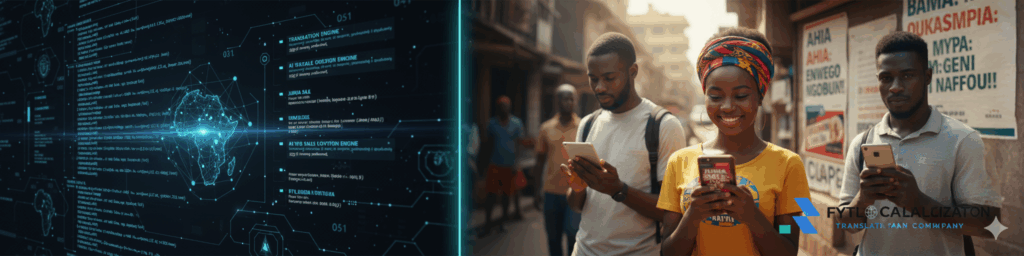
But AI alone often misses what makes a message local — the idiom, the metaphor, the register. That’s where humans’ expertise is needed to preserve meaning, tone, and cultural nuance.
Why Human Expertise Remains Irreplaceable
No model fully understands local humor, historical reference, or the emotional shade of a phrase. Human linguists and cultural specialists fill those gaps: they tune tone, select idioms, and choose visuals that will land correctly.
An illustrative example can be seen in a fintech onboarding
A fintech team used AI to auto-draft onboarding copy into Nigerian Pidgin. Human linguists then refined tone and swapped abstract examples for locally familiar merchants and payment flows. The result: clearer sign-up instructions and fewer abandoned registrations during onboarding in the targeted region.

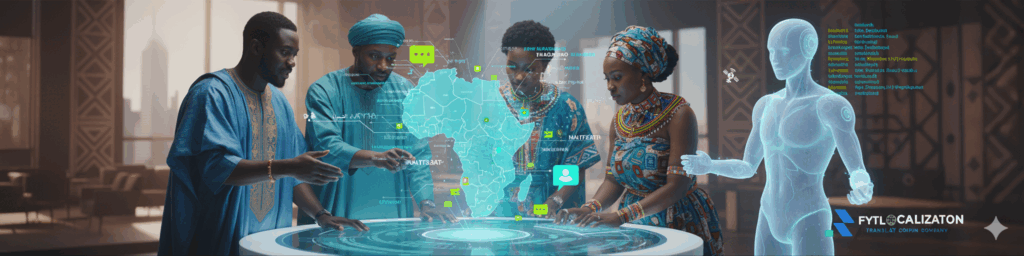
The best results come when these human skills work alongside AI — combining scale with sensitivity. The workflow below shows how that collaboration happens in practice.
The winning formula: AI + Human — a practical workflow
Here’s a practical, repeatable workflow that balances speed and cultural accuracy:
- Discovery & prioritization — map target markets and identify priority languages/dialects.
- Glossary & style guide — define brand terms, tone, and forbidden phrases.
- AI Drafting — use NMT and ASR (speech-to-text) to create initial drafts and subtitle baselines.
- Human Post-Editing — native linguists refine idiom, tone, and local examples.
- UX & cultural QA — micro-tests, focus groups, or in-market pilots to validate choices.
- Integration & automation — push final assets to CMS, app builds, or video platforms; implement version control.
- Measure & iterate — track engagement, conversions, support tickets, and iterate.
This pipeline reduces time-to-market while ensuring culturally appropriate messaging — the balance every modern brand needs. It already delivers measurable results. Here are real-world examples that show how this approach works in practice.
“AI gives speed. Humans give soul.
Together, they give Africa a louder, clearer voice.”
Real-world applications that show impact
Video & entertainment (Nollywood style): AI generates subtitles for a film; human editors adjust timing and localize jokes so the film plays naturally across East and West African audiences.
Public health outreach: ASR captures community feedback; linguists craft clear health advisories in Tiv and Ibibio, using local proverbs to boost recall and compliance.
E-commerce localization: A retailer localizes product descriptions, sizes, and payment instructions for multiple Nigerian regions. Localized UI and labels reduce returns and increase repeat purchases.
Each of these uses the same principle: let AI handle the heavy lifting and humans ensure authenticity.
Successful programs also rely on rigorous controls. Let’s look at the quality steps that keep translated content trustworthy at scale.
Quality controls & responsible AI use
To maintain trust and quality at scale, implement these controls:
- Tiered review: AI draft → native editor → senior cultural reviewer.
- Glossary enforcement: consistent product names and terminology across channels.
- In-market testing: small rollouts or A/B tests to catch cultural misfires.
- Bias checks & safety: review AI outputs for harmful bias or stereotyping.
- Data security: encrypt sensitive content and follow client data policies.
When clients understand these checks, they trust the process — and that trust is invaluable.
Successful programs also rely on rigorous controls. Let’s look at the quality steps that keep translated content trustworthy at scale.
KPIs that turn localization into a business case
When you sell localization to stakeholders, focus on measurable outcomes:
- Engagement uplift — time on page and video completion for localized assets.
- Conversion lift — localized landing page conversion vs. baseline.
- Support reduction — fewer help tickets because instructions are clear.
- Time-to-market reduction — how quickly a campaign goes live across languages.
- Customer retention — repeat purchase lift in localized cohorts.
These metrics move localization from “cost” to “growth lever.”
Metrics help, but real projects still face practical obstacles. Here are frequent challenges and how to address them.
Challenges & practical fixes
- Dialect complexity: prioritize by user density and business impact.
- Resource scarcity: train community linguists and build shared glossaries.
- Operational friction: integrate TMS (Translation Management System) into product pipelines.
- AI limitations: always assign humans to culturally sensitive content.
Practical solutions require an operational partner. Here’s how FYTLOCALIZATION designs hybrid programs that scale while preserving authenticity.
FYTLOCALIZATION’s approach: practical, scalable, human-first
At FYTLOCALIZATION our promise is simple: technology for scale; humans for soul. We map languages and dialects by priority, use AI to accelerate drafts, and rely on native speakers to ensure cultural fit. We run in-market tests and measure outcomes, so clients see the business value of every localized asset.
Whether you’re launching a product in Lagos, running health outreach in rural regions, or distributing video content across East and West Africa — we build localization pipelines that deliver results.
With that approach in place, what does the future hold for translation across Africa?
A look ahead: what to expect next
Expect richer voice experiences, real-time interpretation for live events, and AI models better trained on African dialects. But the constant will remain: people decide what is authentic. Organizations that pair technology with human judgment will lead the next wave of meaningful communication.
If you want your brand to benefit from these advances — quickly and authentically — here’s a simple next step.
Call to action
If you’re ready to scale in Africa — with translations that sound local and feel trusted — let’s talk. If you want your messages to be felt, not just heard. Request a free localization assessment and receive a prioritized language map and a sample localization plan for one campaign.
Contact us for a free localization assessment: fytlocalization.com
Tagline: Connecting the World Through Language