
Introduction — why translation is a business decision, not just a language task
Expanding into a new market is a strategic gamble: you invest in product adaptation, distribution, marketing and customer support, all to win the trust of new customers. Yet one overlooked line item often determines whether that gamble pays off: translation quality. A poorly translated website, product label, training manual or customer message doesn’t just create confusion, it erodes trust, damages reputation, and carries real financial and legal risk.
The hidden cost of poor translation is not measured in missing commas, it is measured in lost customers, weakened brand equity, regulatory friction, and wasted marketing spend. And as localization technology advances, the stakes are changing fast: speed and scale are available like never before, but so are the consequences of publishing language that misses the mark.
First impressions cost more than you think, how a single mistake becomes expensive.
When an unfamiliar audience reads awkward or incorrect language from your brand, their immediate reaction isn’t technical critique — it’s emotional: confusion, skepticism, or even offense. That emotional response translates into business outcomes: lower conversion rates, higher churn, fewer referrals.
Consider this logic chain: one poorly translated product description → customers misunderstand how to use the product → increased returns and support tickets → negative reviews and lower search ranking → higher acquisition costs. Over time these effects compound.
Historical examples show how language errors can harm a brand’s image and reach. Iconic mistranslations (from international ad campaigns that didn’t land) remain a stark reminder: translation errors can be more than embarrassing — they can be costly.
Beyond embarrassment — The legal, safety, and regulatory risks
The stakes rise quickly when translation errors touch regulated areas: healthcare labels, financial terms, safety warnings, and contractual clauses. A misplaced word on a medical leaflet or an imprecise instruction on an appliance manual can cause harm and trigger legal liabilities.
This isn’t hypothetical. Recent scrutiny of AI transcription systems in healthcare, for example, has raised worries about accuracy, errors and hallucinations in transcripts have led researchers and regulators to flag potential patient-safety problems. This shows how even advanced tools can introduce real-world risks when used without careful human oversight.
If risk and liability scale with irresponsibly deployed language, then the next question is how companies are adapting, and what the modern localization stack looks like.
The modern localization stack: speed, scale, and the new fault lines
Today’s translation ecosystem looks very different from ten years ago. Large models and neural machine translation (NMT) projects — such as Meta’s No Language Left Behind (NLLB) and other research efforts — have expanded support for many low-resource languages and improved baseline quality across hundreds of languages. These advances create enormous opportunity for brands to reach more audiences quickly.
At the same time, major platforms (Google’s recent expansions into African languages, for example) have broadened access to machine translation and offline support — effectively lowering the cost of entry for multilingual publishing. But while these tools increase reach, they also highlight a new fault line: the difference between a machine draft and a market-ready message.
So, if technology enables reach, how do companies ensure quality? The answer lies in robust workflows that combine automation with human expertise.
The hybrid model: where automation meets cultural intelligence
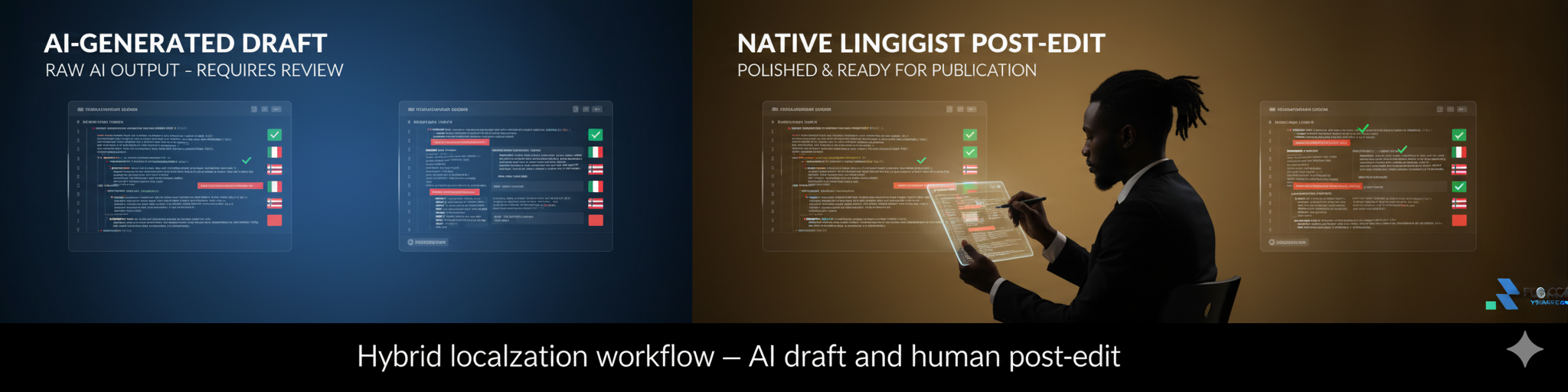
Smart localization teams use a hybrid model: machines for speed and volume; humans for context, tone, and legality. That model typically looks like this:
- Glossary & brand-mapping — define voice, forbidden terms, and product-specific terminology up front.
- AI draft — NMT or LLMs produce first-pass translations or transcriptions (fast).
- Human post-edit — native linguists correct idiom, tone, and register; check cultural fit.
- In-market micro-testing — soft launches or community checks to validate comprehension.
- Analytics & iteration — track conversions, support metrics, and feedback to refine the glossary and models.
This workflow reduces turnaround time while preserving authenticity — and it’s now a standard in scalable localization operations.
Tools such as Rask.ai and other multimedia localization platforms automate subtitle and dubbing pipelines, helping teams scale video work, but they still require native reviewers before public release.
Trending risks and opportunities in 2024–2025 (what businesses should watch)
This is where the industry is changing rapidly — and where many companies either win or lose:
- AI expands language coverage: Projects like NLLB and big-platform updates have added many African and low-resource languages to usable translation sets. That increases opportunity — but many of these models still need local tuning.
- Voice and real-time translation are maturing: Speech-to-text and real-time captioning have improved dramatically, enabling webinars, customer support and events to cross language barriers in near real time. Yet studies evaluating ASR systems (e.g., Whisper) show performance gaps across accents and contexts — which can cause errors in high-stakes settings. In short, real-time is powerful — but not infallible.
- Regional investment in language tech: Telecoms and regional players are investing in localized AI models (e.g., partnerships to refine LLMs for African languages), indicating that high-quality, region-specific models will improve over the next 12–24 months. Such collaborations will be important for lowering the error rate in local dialects.
- AI hallucination & safety concerns: Across sectors (healthcare, legal, public policy) regulators and researchers are calling for stricter checks because transcription and translation tools can hallucinate content or invent details — a serious risk where accuracy matters most.
These trends mean businesses must balance speed with responsible governance. The next section shows how to turn that balance into measurable business outcomes.
Calculating the hidden cost — How to quantify risks and returns
To understand the true cost of poor translation, companies should measure both direct and indirect impacts:
Direct costs
- Rework, recalls, and legal fees from incorrect labels or contracts.
- Support center load increases (more tickets; longer resolution times).
- Refunds and returns driven by misunderstood product info.
Indirect costs
- Lost lifetime value due to reduced trust and repeat purchases.
- Brand damage leading to lower conversion rates.
- Missed partnerships and slower market rollouts due to poor local credibility.
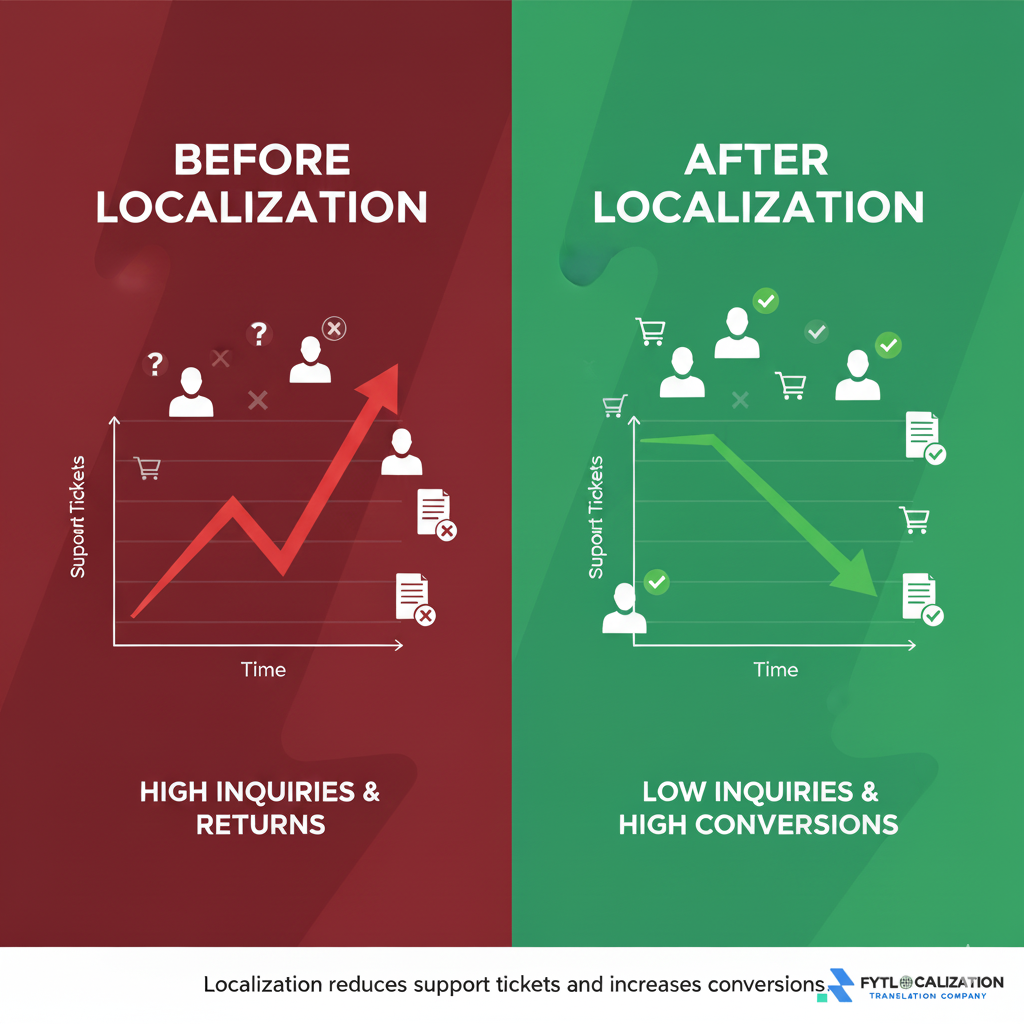
Example KPI map:
- Track conversion lift on localized pages vs. non-localized pages.
- Monitor support ticket reduction in markets after localized content is deployed.
- Measure time-to-market before and after AI-assisted localization workflows.
These metrics turn localization from an expense category into a demonstrable growth lever.
Practical playbook: How to avoid the hidden cost (step-by-step)
If you’re preparing to expand, here’s a short, actionable checklist to reduce risk:
- Prioritize touchpoints — start with onboarding, product labels, and customer support scripts.
- Build a glossary — capture product-specific terms and test translations in-market.
- Use AI carefully — employ NMT and ASR for draft work, but require native post-editing for customer-facing content.
- Test in-market — run small A/B tests or field checks before full campaigns.
- Set governance — define approval levels (who signs off on legal, marketing, and technical translations).
- Track value — instrument pages and assets to measure conversions, retention, and support load.
This playbook protects growth investments and keeps localization aligned with business outcomes.
Here is a Real-world example.
Case A — E-commerce product clarity
A retailer localizes product descriptions into regional languages using a hybrid pipeline: NMT for bulk drafts; native editors for product names and sizing. Result: returns fell and conversion rose in localized regions.
Case B — Health outreach clarity An NGO used ASR to transcribe field interviews, then had linguists craft regionally appropriate PSAs. Result: improved attendance and clearer community response.
Note: These are generalized patterns you can replicate; your team can replace them with specific metrics after piloting. The pattern is the lesson: scale with AI, validate with people.
Governance, ethics, and data security — These are non-negotiables
As you scale localization, pay attention to governance:
- Data privacy: enforce encryption and data minimization when handling customer voice and personal data.
- Transparency: disclose AI use to partners and clients when relevant; explain human review steps.
- Bias checks: regularly audit outputs for cultural bias or harmful language.
- Compliance: ensure translations for regulated content are reviewed by legal or certified linguists.
These governance steps turn localization into a responsible, brand-safe capability.
Conclusion — Invest in clarity, protect your growth
As markets globalize, language becomes a strategic asset — not a checkbox. The hidden cost of poor translation is real and measurable: reduced revenue, higher operating costs, and reputation damage. Today’s AI-powered tools open new possibilities for speed and scale, but they also introduce new risks that must be managed with human expertise, governance, and measurement.
If your growth plan includes new markets, treat localization as a core business function: prioritize customer-facing touchpoints, adopt a hybrid AI + human workflow, and measure outcomes. Done well, localization becomes an engine for growth rather than a source of risk.
FYTLOCALIZATION partners with organizations to design these exact workflows — combining technology, native linguistic expertise, and governance to protect your brand and accelerate expansion.
👉 Ready to audit your translations or pilot a hybrid localization project? Contact FYTLOCALIZATION for an assessment.